Offset accounts: how they work and what to compare
We can help you work out whether an offset account would save enough interest to justify its cost. It lets you keep money in a linked account while reducing the balance used to calculate home loan interest. The result depends on the balance you hold, the loan rate and any extra fees.
Here's a plain-English explanation of what a 100% offset account is, how it functions day to day, and what to weigh up before deciding whether one suits your situation.
What Is an Offset Account?
An offset account is a transaction account linked to your home loan. The balance you hold in that account reduces the loan balance on which interest is calculated — it doesn't repay the loan directly, but it shrinks the figure the lender uses when working out your daily interest charge.
There are two common types:
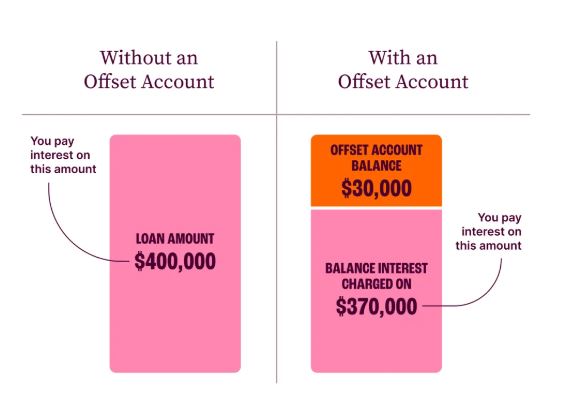
- 100% offset account: Every dollar in the account reduces the loan balance used for interest calculation, dollar for dollar. If you have $30,000 in the account and a $400,000 loan, interest is charged on $370,000 rather than the full $400,000.
- Partial offset account: Only a portion of the account balance is applied to reduce the interest calculation. These are less common and generally less effective.
The examples below use a 100% offset. Confirm the offset percentage and eligible loan portion for the product you are considering.
How Does It Work Day to Day?
Interest on most Australian home loans is calculated daily. Each day, your lender subtracts your offset account balance from your loan balance before applying the interest rate. The more money you keep in the account, and the longer it stays there, the more interest you avoid paying.
Because the account functions like an everyday transaction account, you can have your salary paid into it, pay bills and direct debits from it, and use a linked debit card. The offset benefit is working continuously in the background.
To illustrate the mechanics: a $400,000 loan with $30,000 sitting in an offset account means interest is charged on $370,000. That difference compounds over time. Maintaining a consistent offset balance while keeping up your regular principal-and-interest repayments means more of each payment chips away at principal rather than covering interest — which can shorten the loan term.
These figures are illustrative only. Your actual outcome depends on your loan balance, offset balance, interest rate, loan term and any applicable fees.
Offset Account vs. Redraw Facility
These two features are often mentioned together but work quite differently. An offset account is a separate linked transaction account — your money stays accessible like any bank account, and withdrawals are straightforward. A redraw facility involves making extra repayments directly onto the loan; those funds reduce your loan balance immediately, but accessing them later depends on your loan contract and the lender's rules.
Both can reduce interest, but access conditions differ. If you might later rent out the property or use money for investment, ask a registered tax adviser about the consequences of redraw versus withdrawing from a separate offset account. We can explain the lender’s features and terms.
The Tax Efficiency Point
One reason offset accounts appeal to borrowers is the way they interact with tax. Interest earned on a savings account is assessable income — you pay tax on it. When you use an offset account instead, you're not earning interest; you're reducing the interest charged on your loan. For a correctly structured arrangement where there's no entitlement to deposit interest, the benefit arises as reduced loan interest rather than taxable income.
This is not a blanket tax exemption, and the position can be more nuanced for investment loans. ATO Taxation Ruling TR 93/6 sets out the conditions under which loan account offset arrangements are acceptable, including the requirement that the deposit account carries no entitlement to receive interest. If the loan is used for investment purposes, any deduction for interest is limited to the reduced amount actually charged after the offset. For your specific situation — especially if you hold or are planning an investment property — speak with a registered tax adviser rather than relying on general guidance.
Is an Offset Account Worth It for You?
We compare the interest benefit from the average balance you expect to hold with any higher loan rate or fees. A larger offset balance can increase the benefit, up to the linked loan balance; a larger mortgage alone does not make the same offset balance save more at the same rate.
It may be less worthwhile if:
- Your savings balance is consistently low — the interest saving will be modest
- The loan comes with higher fees or a higher interest rate to include the offset feature — those costs can erode or eliminate the net benefit
- You're on a fixed-rate loan — offset accounts are generally not available on fixed-rate products, though availability varies between lenders
ASIC's Moneysmart guidance puts it plainly: compare the cost of any fees against the interest you realistically expect to save, and be honest about the balance you'd actually maintain. A higher loan rate or annual package fee can quietly offset the offset.
One Thing Many Borrowers Miss: Check the Link
An offset account only works if it is correctly linked to your home loan. ASIC has found that some lenders failed to properly manage offset accounts, meaning customers were unknowingly paying more interest than they should have — sometimes for years — without their repayments changing to signal the problem.
After settlement, and again after any refinance or product switch, confirm through your online banking or statements that the offset account is actively reducing your interest. If you can't see the saving reflected, contact your lender directly. Refinancing can break the link, so it's worth checking each time your loan changes.
What to Weigh Up Before You Proceed
- Interest rate: Would the rate be lower on an otherwise comparable loan without an offset feature? Even a small rate difference can matter over a 25–30 year term.
- Fees: Some lenders charge monthly or annual fees for offset-eligible loans or the account itself. Factor these into any comparison.
- Loan type: Confirm whether an offset is available on the specific product you're considering, particularly for fixed-rate terms.
- Investment property plans: ask your tax adviser to review the loan’s use and history before changing it or withdrawing funds. The property becoming a rental does not automatically make every part of the loan interest deductible.
- Interest-only loans: Reducing interest through an offset doesn't automatically pay down principal on an interest-only loan. The loan term doesn't shorten unless principal is also being repaid.
Ready to Work Out If It Makes Sense for Your Loan?
Whether an offset account is worth it depends on your loan size, the balance you can realistically maintain, the rate and fees attached to the product, and your broader financial plans. We can help you compare options across our panel of banks and non-bank lenders and work through whether the numbers stack up for your situation.
To talk it through, get in touch with our team — by phone on 1300 955 791, by email at info@natloans.com.au, or book a free consultation online. We're available Monday to Friday, 9.00am to 5.30pm.
You may also find these articles useful as you think through your home loan strategy:
- Stamp Duty Abolished on New Homes for Eligible First Home Buyers in Queensland: What It Means for You
- Your Guide to Smarter Car Loans and Asset Finance
This article is general in nature and does not constitute financial, tax or legal advice. Loan approval and terms depend on lender assessment. Tax treatment depends on your individual circumstances and the structure of your loan — confirm with a registered tax adviser.
Images on This Page
-
https://www.natloans.com.au/wp-content/uploads/2026/04/natloans-white-logo.webp
(no alt text)
-
https://www.natloans.com.au/wp-content/uploads/2025/04/natloans_logo.png
(no alt text)
-
https://www.natloans.com.au/wp-content/uploads/2025/04/image-17-150x150.png
Picture of By Mary Nebotakis, Managing Director, Natloans, B. Eco, Dip. Financial Services
-
https://www.natloans.com.au/wp-content/uploads/2025/03/iStock-688344476.jpg
Blue piggy bank beside a small house folded from Australian banknotes.
-
https://www.natloans.com.au/wp-content/uploads/2025/03/Offset-explained.jpg
Offset account example: without an offset account, interest is calculated on a $400,000 loan. With a $30,000 offset account balance, interest is calculated on $370,000.
-
https://www.natloans.com.au/wp-content/uploads/2026/04/NL0426-02_Awards_HORIZONTAL-scaled.png
Natloans industry awards and recognition
-
https://www.natloans.com.au/wp-content/uploads/2026/04/natloans-awards.png
Natloans industry awards and recognition
-
https://www.facebook.com/tr?id=643672049431657&ev=PageView&noscript=1
(no alt text)